
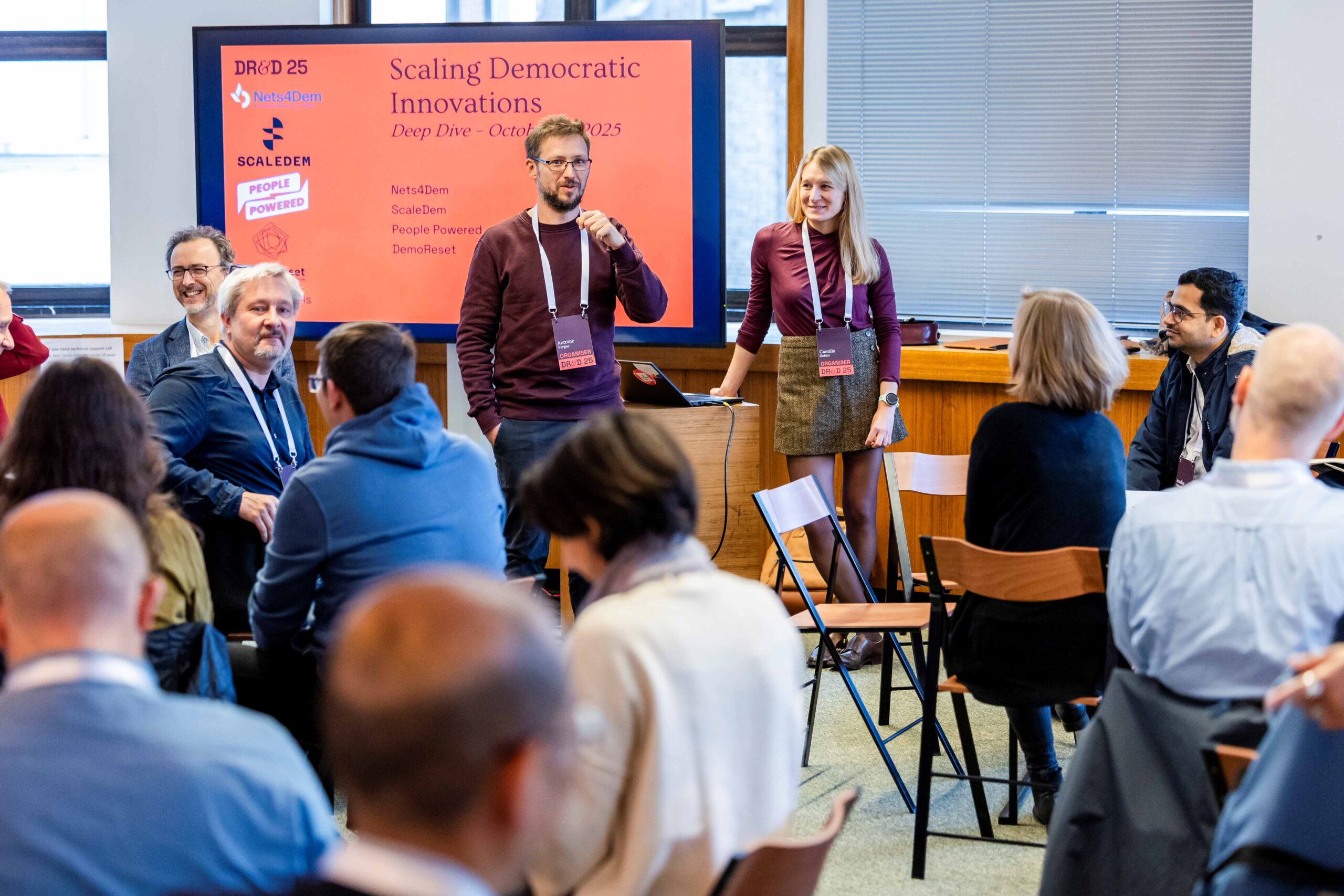
Brussels has a way of turning big questions into working conversations. The city recently hosted the Democracy R&D Annual Conference, two packed days on 15–16 October with pre- and post-programme events on the 14th and 17th, bringing together three hundreds practitioners, officials, researchers and funders to ask where deliberative democracy goes next. With Missions Publiques among the host organisations alongside FIDE, G1000 and Democratic Society, we helped shape a gathering that mixed off-the-record exchanges with hands-on sessions and public dialogues across the city.
The setting mattered. Belgium is one of the few places where permanent citizens’ assemblies are now part of the institutional mix, from the German-speaking Community to Brussels and Wallonia; in Brussels, democratic innovations have long moved already from pilot to practice.
Did you know that statistically – in Brussels, around *20%* of households— 1 in 5 residents—have received already received a letter to take part in one of the many deliberative mini-publics organized to help shape the future of the Region? This diffuse deliberative culture in Brussels sharpened the questions in the room: not whether deliberation works, but how it can be made routine, inclusive and durable when politics gets rough.
Deliberative Democracy at “Crossroads”
“Crossroads” was the theme of this annual edition. It meant three things we kept coming back to in the deep dive session we co-designed and facilitated with Nets4Dem, DemoReset and People Powered.
We began by harvesting lived definitions of “scale”—institutionalisation that outlives the project; spread with variety rather than monoculture; cultural roots that make participation ordinary; and the craft that keeps quality intact as volume rises. Only then did we stress-test the four-lens map from our ScaleDem project, and three lessons emerged from the discussion
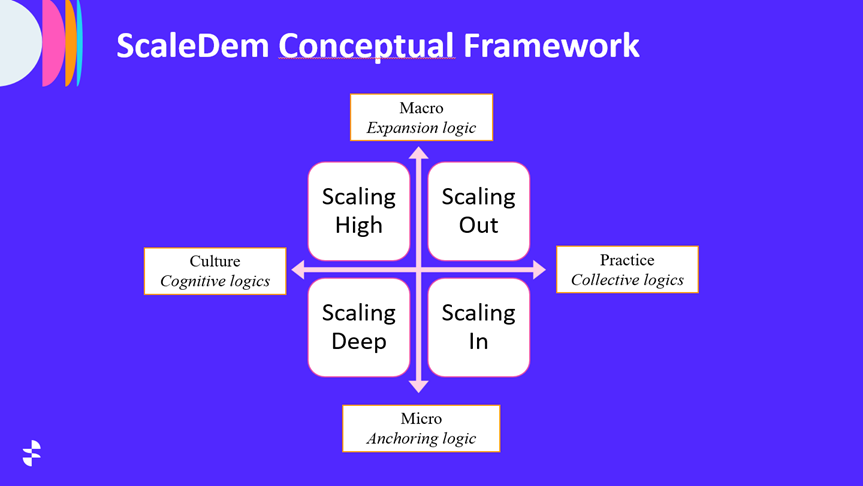
First, the choir problem: a self-critical thread ran through the conference: too many of our processes still speak mainly to insiders. If we want to scale deep, we have to involve the people already holding the line in tough contexts— social movements, local communities, cultural and educational institutions and independent media—so that deliberation grows in the places where democratic culture is actively being defended.
In Brussels, colleagues argued that this cultural work is not a “nice to have”; it’s the backbone that makes scaling high more than a legal fix. As a field, have we been too obsessed on political institutions and the institutional pathway to scaling democratic innovations? We left with a clearer sequence: continue building capacities within institutions (scaling high) sure, but normalize also from the bottom up (scaling deep) by bringing in new actors, then codify (scaling in) — so that when mandates come, they rest on lived practice rather than performative adoption.
Second, the democratic divide. The conversations around corridors and coffee tables kept circling back to unequal access—to funding, to training, to time, and between well-resourced private actors and public or grassroots organisations who are struggling. If democracy becomes a luxury good, we’ve already lost. For our part, the ScaleDem programmes we presented in Brussels aim to help close that gap. Our Piloting Programme supports ambitious, real-world experiments for up to €100,000 over twelve months, giving teams the space and coaching to test bold enablers of scale. Our Twinning Programme funds action-learning communities—an experienced mentor with up to four mentees—to adapt proven scaling approaches across contexts, with communities financed up to €65,000. Both are designed to go beyond replication, and support lower barriers to entry, transfer what works, and support those keeping democratic space alive in difficult political and budgetary conditions.
Both calls will be opened on December 1st and accept applications until end of March.
Third, fragmentation versus community. By the end, the room was blunt: without coordination, spread stalls, mandates wobble, and quality erodes. With coordination, scale becomes a pathway rather than a slogan.
Our field has never been richer in offers—labs, accelerators, networks, trainings—yet for a city officer or civil society organiser, the map can feel like overlapping brands rather than a shared ladder. As host, we showcased offers that already move the needle. Nets4Dem’s trio—Democracy Labs, the six-month Democratic Innovation Accelerator, and the Rising Stars Mentorship —has convened practitioners across countries, with strengths in scaling out and scaling in. People Powered’s Mainstreaming Participation Playbook and Accelerator is helping coalitions move from strategy to implementation—explicit support for anchoring participation in rules, routines and budgets, in other words, in scaling in. We placed ScaleDem’s Pilots and Twinnings next to these, not as a new brand in a crowded market, but as complementary steps in a shared infrastructure to further boost scaling. The promise is simple: if we coordinate our offers and share measures, anchoring stops being luck and starts being likely.
If “crossroads” was the theme, “choices” is the takeaway. We can choose coordination over branding. We can choose to widen the circle beyond our familiar networks. We can choose to design funding so that those working under democratic stress are first in line rather than last to know. Brussels didn’t hand us a silver bullet; it handed us a clearer map and a community willing to use it. We’re grateful to our partners and to everyone who challenged us to think and do better, and we’re carrying that challenge into the ScaleDem open calls and the months of work ahead.